Wednesday, February 24, 2021

How to Write a Business Plan


Business Plan Basics

by Janet Attard
Last Updated Saturday, February 20, 2021
Learn the basics of why you should write a business plan and what the key elements are.
How to write a business plan
Image source: iStock.com

Business experts frequently tout the importance of business plans. Startups and existing business owners, however, often don’t create a business plan unless they’re applying for a loan or looking for investors. Some simply don’t know how to write a plan. Others tell themselves there’s no need to waste time researching and writing out a plan because they have everything planned out in their mind.

What’s the right approach for your business? Here are business plan basics to help you decide whether or not to write a business plan and how to write one if you choose to do so.

Thanks to Janet Attard for the article : Business Plan Basics (businessknowhow.com)

Monday, March 16, 2020

Facebook Attribution: A Timely Tool for Online Advertisers


Facebook Attribution: A Timely Tool for Online Advertisers

Doug Cameron Social Media Strategist Author

The Situation

Every year, businesses of all types invest billions of dollars into digital marketing. Marketing Charts estimates that the online advertising market is already $30 billion larger than TV advertising. We have data that forecasts these digital marketing dollars are only on pace to increase from 44% of total marketing budgets to 54% by 2024.
Not only has this market’s spend grown exponentially in the last 10 years; its number of channels has, as well. Companies are now afforded numerous sources to advertise their goods and services online.
With options ranging from paid search to affiliate marketing to marketplace advertising, it can be difficult for CMOs to decide where to invest. What makes this decision even more challenging is determining how to measure each channel specifically and measure overall investment holistically.
There are many tools and software solutions available. How can businesses decide which ones to use?

The Solution

At ROI Revolution, we take measurement seriously. At our inception, we understood that businesses aren’t just in need of digital marketing strategies but also insights into how their ad dollars drive sales.
For many beginning and experienced digital marketers, Google Analytics (GA) has been a consistent source of truth to measure contribution across channels. The platform offers standard last touch models as well as top conversion path and assisted conversion reports that provide valuable insights into what sources are contributing to sessions and bottom-line revenue.
For years, ROI used GA as a barometer for our clients’ success in paid channels. However, the platform has one major pitfall: its cookie-based tracking, meaning it sees the mobile and desktop visitor as two separate users.
In a world where mobile browsing is increasing exponentially, this can be a crippling feature.
According to PixelUnion, roughly four out of five Americans are now online shoppers, with more than half having made purchases using a mobile device. The source also states that 90% of consumers claim they use multiple devices to complete everyday tasks, while 40% say they use their mobile device to conduct research prior to making a purchase.
These cross-device shopping trends have led us to look at alternative tools to measure performance for our clients.
Insert: Facebook. The social media giant’s latest measurement tool – aptly named ‘Attribution’ – is making waves across the digital marketing industry. Similar to GA, it offers standard last touch models (amongst others) along with robust conversion path reports.
However, it paints a new picture with people-based tracking.
Using its Pixel, it can track people across devices and browsers as long as they are logged into Facebook. If you haven’t heard yet, Facebook now boasts 2.4 billion monthly users, encompassing over 25% of the world’s population.
Facebook can also track users who aren’t logged in through its back-end ‘Advanced Matching’ feature.
All said, Facebook Attribution is a timely tool for our agency and all online advertisers.

The Results

At this point, you may be left wanting a taste of this alternative measurement tool. You’re in luck, because ROI Revolution has been leveraging this tool since late 2018 – so we have had plenty of time to learn its functionality and best use cases.
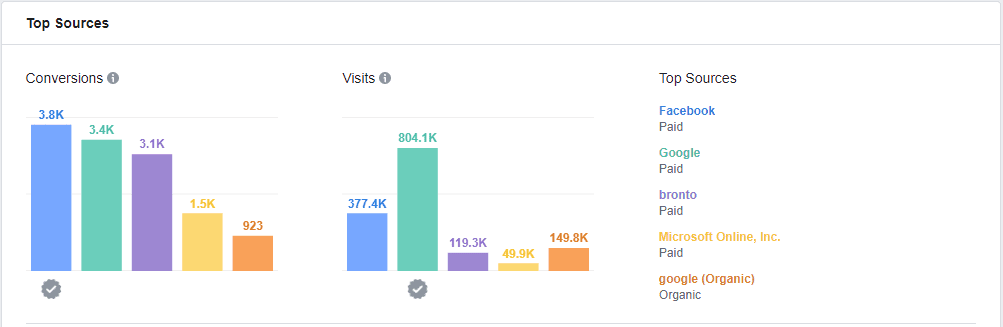
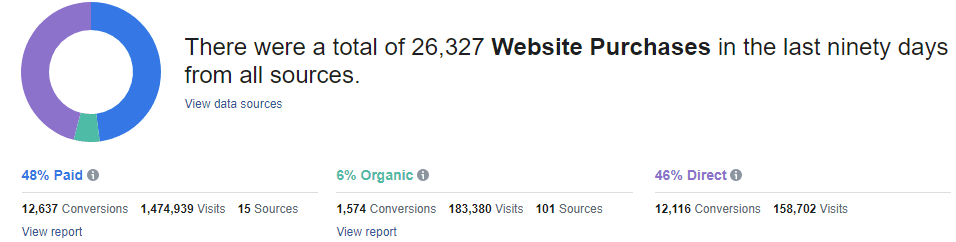
Screenshot showing website purchases in last 90 days
Bar charts showing conversions and visits
As mentioned earlier, Attribution offers a simplified dashboard for holistic account performance. It also provides unique flexibility in valuing sources throughout the funnel through seven distinct attribution models ranging from last click to even credit.
We use this data to monetize upper-funnel campaigns for our clients. Historically, it was challenging to understand how these efforts were driving sales. However, with this tool, we can measure the value generated from a brand awareness campaign that launched three months ago.
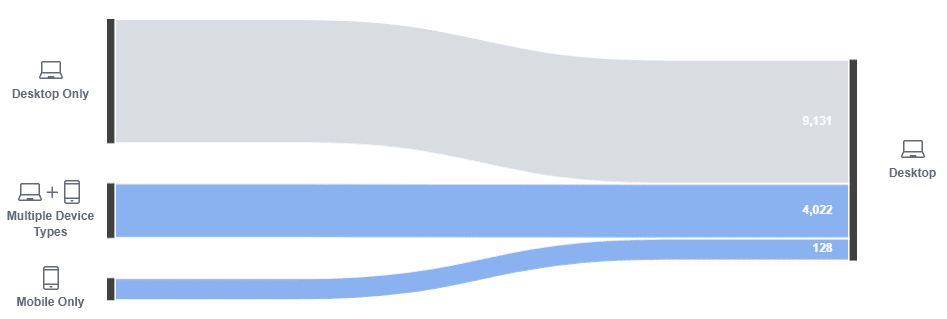
Chart showing device traffic
Thinking back to cross-device shopping trends, Facebook Attribution provides curated insights on up to 90 days of customer conversion paths. We use the learnings from these reports to inform our optimizations, targeting, and ad content across all paid sources.

Summary

We have seen Facebook Attribution become an increasingly reliable and powerful source for measurement for our clients. Analyzing all sources at once and understanding what touchpoints provide the most value has proven extremely useful. It has allowed us to credit platforms for driving the first, middle, and last interactions with users.
Knowing which levers to pull when trying to boost a segment of the conversion funnel has informed our budget allocation strategies and ultimately generated increases in our clients’ bottom lines. We strongly encourage our clients and all digital marketers to leverage this tool (amongst others) as they decide where and how their digital ad spend is driving performance.

Our team can provide you with a free social media advertising opportunity review to help drive your ecommerce brand growth. We also have plenty of free resources to help you on your social media advertising journey:

Optimizing Pinterest Conversion Campaigns to Supercharge Sales

Optimizing Pinterest Conversion Campaigns to Supercharge Sales 

Pinterest is a great way to build your brand's awareness and encourage users to explore your products. Find out how to best optimize your Pinterest campaigns to reach new users and create customers.
Article nominated by 18272184.

Pinterest is known as an idea hub, with content to help users do everything from sparking ideas about home décor to finding new dinner recipes to exploring wedding ideas.
For advertisers, Pinterest is a great way to build brand awareness and encourage users to explore your products.
Since the addition of advertising capabilities in 2013, Pinterest campaigns have been focused on growing top-of-funnel awareness. With keyword and interest group targeting, Pinterest advertising is suited for retailers or ecommerce businesses looking to reach new users in their product category or industry.
With the addition of the conversion campaign objective, Pinterest is taking a step down the funnel and allowing businesses to design campaigns optimized for purchases.

What Are Pinterest Conversion Campaigns?

A Pinterest conversion campaign has four different optimization events to choose from:
1. Check Out
2. Sign Up
3. Lead
4. Add To Cart
Advertisers can choose their desired event and the algorithm will seek out users likely to complete it. This is the first campaign type Pinterest has launched that is directly focused on increasing ecommerce events.

How Do Pinterest Conversion Campaigns Work?

The first thing an advertiser needs to launch a conversion campaign is a Pinterest Tag – a piece of code installed on the company’s website that tracks users from Pinterest to their website. Pinterest Tags measure events like pageviews, add-to-carts, and purchases.
This campaign type requires advertisers to enter their target CPA, which informs the algorithm of how much the advertiser is willing to pay for the conversion event.
The target CPA needs to be high enough to ensure delivery in relation to your bid and budget. For example, if your target CPA is $15 and your daily budget is $180, then your maximum number of events is 12.
When choosing the conversion window, advertisers should consider how long it takes their typical customer to decide to purchase. This will inform which users the Pinterest algorithm looks for. It is also important to take into account how users interact with Pinterest, such as how often they are viewing content versus how many times they click on content.

Pinterest Conversion Campaigns Best Practices

Once your conversion campaign is live, it enters Learning Mode. In Learning Mode, the Pinterest algorithm learns about your audience settings and finds ideal users. The algorithm requires 50 to 200 conversions per week to fully optimize the delivery system and exit Learning Mode.
When the campaign is in Learning Mode, it is recommended that advertisers do not make changes. This could reset the process.
Once the campaign exits Learning Mode, advertisers should allow three to five days between changes to limit any disruption to delivery. When adjusting the bid or budget, the best practice is a 9-15% change, no more than three times per week.
To achieve the minimum number of conversions in Learning Mode, Pinterest recommends using broad audience targeting and relying on the Pinterest Algorithm to find users likely to complete the conversion event.

Pinterest Conversion Campaigns in Action

An ROI Revolution client that sells fine jewelry became eligible for this campaign objective in Q3 2019. By targeting site visitors in the past 30 days, the campaign achieved a 1,072% return on ad spend. The ad set served in the Home Feed and was opted into all devices. Comparing remarketing efforts month-over-month, the conversion campaign objective achieved a 238% higher conversion rate at a 44% lower cost per acquisition.
Want to dive deeper into paid social media? Check out some of our most recent resources below: